
Article
Commercial real estate photography for brokers
Commercial real estate photography shows a tenant or investor the things they decide on: access, visibility, parking, condition and the usable space inside. It is planned around the property type and the way the broker will use the images, which is why we price commercial work by quote and not from a flat list. This article walks through what to shoot for each kind of property, where aerials fit, how to get a building ready and what to send us so the quote is accurate.
How is commercial photography different from residential?
A home buyer responds to how a house feels. A commercial prospect is checking facts. Can trucks get in and out? How many parking spaces are there, and where? Can the sign be seen from the road? How high is the clear height, how many dock doors are there, what shape is the suite, where are the columns? Good commercial photos answer those questions plainly.
The images are used differently too. They go into an offering memorandum or a leasing flyer, onto commercial listing sites, into email blasts to other brokers and onto the broker's own site. Several of those are print layouts that need particular shapes: a wide cover image, a vertical for a column, a clean aerial that can carry labels. If you know the layout, say so before the shoot.
Commercial shoots involve more people as well. There may be tenants, customers, employees, a property manager and building security to work around, so access and timing take more planning than a lockbox on a front door.
What should be photographed for each property type?
For retail, the priorities are the frontage and the sign as seen from the road, the full length of the center, the parking field, the entries, the pylon sign with tenant panels, and the available suite inside and out. Show the co-tenancy, since the neighbors are part of the pitch. Shoot from the approach a driver actually takes, in both directions if visibility is a selling point.
For office, shoot the building exterior, the entry and lobby, the elevator lobby, common corridors and restrooms if they have been renovated, the amenity spaces, the parking garage or lot, and the available suite. Inside the suite, show the reception, the open area, a typical office, the conference room, the break room and the window line. Views matter on upper floors, so include what is outside the glass.
For industrial and flex, the list is practical. The front office, the warehouse from a corner that shows its depth and clear height, the dock doors and grade level doors from inside and outside, the truck court and its depth, the yard and fencing, the power and any cranes or special equipment that stays. A person reading the flyer should be able to count doors from the photo.
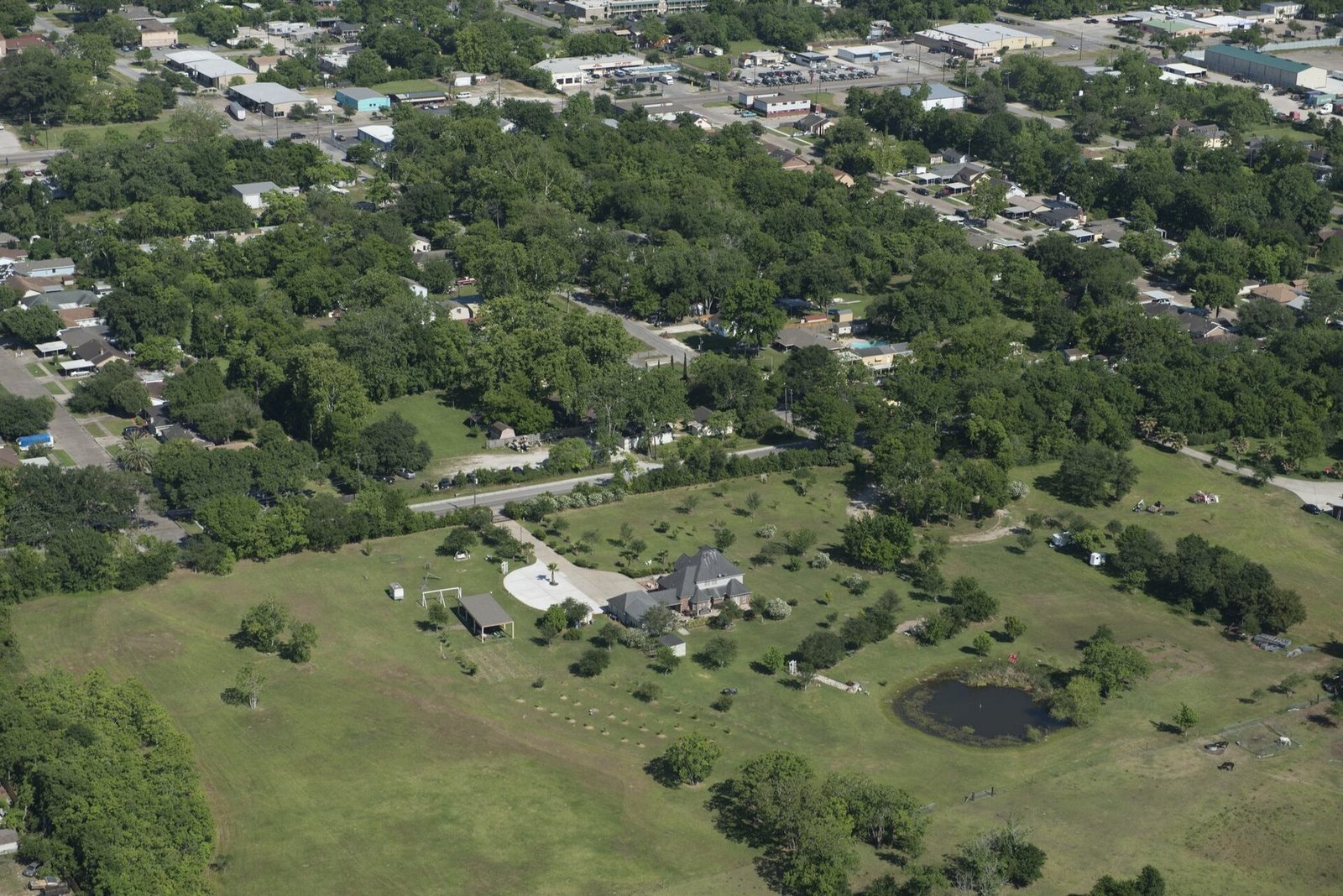
For land, the ground level photos are secondary to the aerials. Show the road frontage, the corner, the entrance, existing drives and any structures. The rest of the story is told from above.
Why do aerials matter so much in commercial listings?
Because location is the product. An aerial puts the site in context in a way no ground photo can: the freeway or tollway it sits on, the feeder road and the nearest exits, the intersection, the traffic signals, the rooftops that feed a retail center, the rail line or port access near an industrial site. Houston is flat and spread out, so a view from above is often the only way to show how a property relates to the roads that serve it.
Brokers commonly use aerials as the base for a labeled map, with the site outlined and the roads and neighbors named, so a clean, high, well exposed image is worth asking for. Lower oblique aerials show the building and its parking, truck court or yard in a single frame. For land, aerials from several sides show the shape of the tract, its frontage, the tree cover, any ponds or detention, and what is being built nearby.
Our drone work is flown by an FAA Part 107 certified pilot. Parts of Houston sit under controlled airspace around IAH, Hobby and Ellington, and a number of commercial and industrial areas fall inside it, so the pilot checks the address as part of planning the flight. Give us the site address early, so there are no surprises on the schedule. If the flight will pass near neighboring businesses, a heads up to the property manager is a courtesy that avoids calls to security.
How should a commercial property be prepared?
Start with the exterior, since it leads every flyer. Have the landscaping cut and the lot swept or blown. Move dumpsters back into their enclosures and close the gates. Remove stray pallets, abandoned carts, temporary banners and old for lease signs that are tattered. If the parking lot has just been restriped or sealed, wait for that to finish. Check that the building and pylon signs are lit and whole, with no dead letters.
Parking is a judgment call. A retail center looks healthy with cars in front of the stores, so shoot it during business hours. An office building or a vacant suite looks best with a mostly clear lot, which means early morning or a weekend. Tell us which look you want.
Inside a vacant suite, the basics are the same as a vacant house. The power needs to be on, every light working, ceiling tiles in place and unstained where possible, floors swept, leftover furniture and trash removed, and blinds opened or pulled up. In a warehouse, turn on all the bay lights ahead of time, since some types take a while to reach full brightness, and open a dock door or two for daylight if it is safe to do so.
What about occupied and tenant spaces?
Occupied properties need notice and consent. Tell tenants when the photographer is coming and what will be shot. In an occupied office, ask for clear desks and screens turned off, and avoid photographing anything confidential, such as whiteboards, documents and monitors. Photos should avoid identifiable people wherever possible, and the simplest way is to shoot common areas and suites before or after business hours.
For an investment sale of a leased center or building, exterior and aerial images often carry the marketing, with interiors limited to common areas. That keeps the shoot from disrupting tenants, which the owner will appreciate. Work out the list with the property manager before you ask for the quote, so the quote covers what you can in fact get access to.
What do we need to quote a commercial shoot?
Send the property address, the property type and rough size, and a short list of what you want covered: exteriors, aerials, common areas, how many suites or spaces, any specific features. Tell us how the images will be used, such as a flyer, an offering memorandum, listing sites or a website, and any deadline tied to a launch. Let us know about access: who will meet us or how we get in, hours that work for tenants, and any security check-in.
If you would like edited video of the property, mention it in the same message, since video is quoted as well. With that information we can give you a clear price and a plan for the day, and you can take it to your client before committing.
One note on the smaller jobs. Land and lot listings are covered by our Drone Only package at a flat $40, which includes aerial photos and a few short unedited drone clips, and that can be booked online without a quote. For everything else commercial, contact us through rephotosvideos.com with the details above and we will respond with a number.
See our Builders & New Construction work, or browse everyone we shoot for →